While the rest of the UK is basking in warm spring sunshine, we awoke to a thick bank of fog which continues to hang over the island. Only a few Willow Warblers and Blackcaps remain. The question is - could there be a mega lighthouse attraction tonight? (c) Richard Brown
Friday, April 8, 2011
Thursday, April 7, 2011
We have been inundated yet again with Willow Warblers, with the day tally again breaking the 400 mark. Smaller numbers of Blackcap and Chiffchaff have also moved through and the first Yellow Wagtail, Redstart, Sedge Warbler and Grasshopper Warblers of the year were logged. Hirundine passage has stepped up a gear with over 200 each of Swallow and Sand Martin. The highlight of today came in the form of a Marsh Harrier which swept across the plantation and over the mountain as we were ringing at Nant.
Sadly my camera was set completely wrong when I grabbed it. But there is still enough here to see that this is a sub-adult male. The 'cream crown' plumage is still well in evidence on the head but the underwings and tail are the silvery colour of a male and the black wingtips are well defined. This is only the 31st record for Bardsey. (c) Richard Brown
Willow Warblers and Blackcaps are being attracted to the lighthouse almost every night at the moment. Sadly the death count continues to be quite high. A Wood Pigeon was also killed last night. (c) Richard Brown
The dark nights have meant that our most abundant breeding bird has started to come ashore in huge numbers. But the Manx Shearwater will not start laying eggs for another three weeks or so. They are currently coming ashore, very noisily, to reaffirm their pair bonds (the majority of Manx Shearwater pair for life) and to prepare their burrows for the breeding season (the majority of pairs use the same burrow each season). On islands where ground predators are absent (such as Bardsey), the only real threat to a breeding seabird comes from other birds. There is thus a distinct advantage to nesting in burrows as the nest is hidden away from aerial predators. Manx Shearwater can therefore take their time with rearing their chick, indeed the incubation period is approximately 51 days and the chick remains underground for about another 71 days after that. So living underground would seem danger free...
...but not always! This Manx Shearwater must have moved just the wrong piece of soil or stone as it cleared a burrow for the coming season. (c) Richard Brown
It's not only birds that are on the move. The Dark Sword-grass (above) is an immigrant to Bardsey. The majority of the catch at the moment is made up of Red Chestnuts and Common Quakers (below). (c) Giselle Eagle
Monday, April 4, 2011
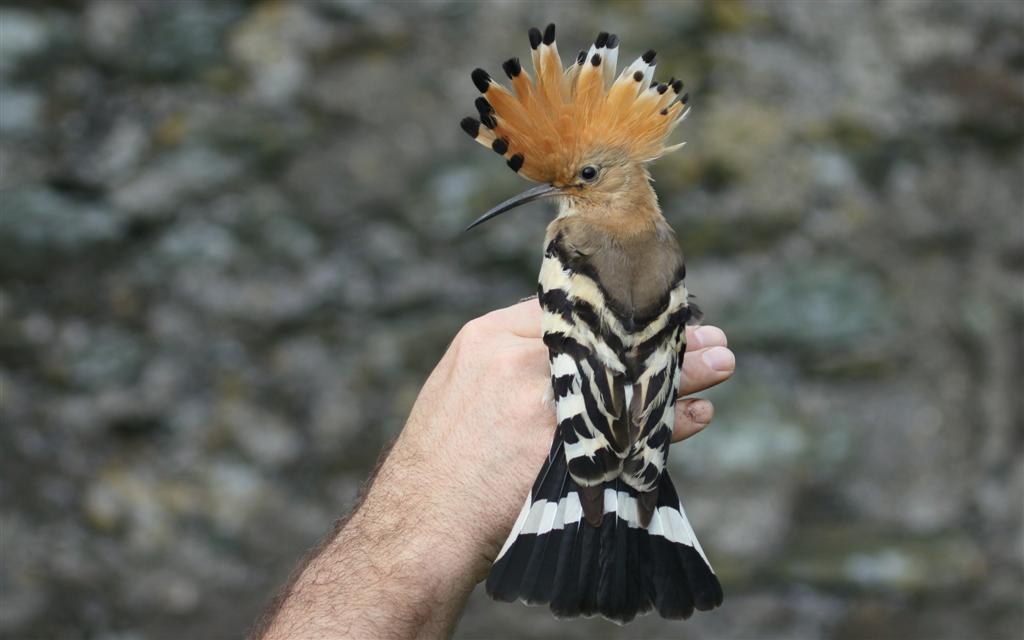
A clear night meant that we could both get some sleep. It also meant that by morning the vast majority of our migrants had continued on their journeys. Indeed we haven't even reached double figures of Willow Warbler this morning as we birded in strong wind and drizzle. But the Hoopoe remains, and this morning it is wearing a ring!
The third Hoopoe to be ringed on Bardsey! A white chin, cinnamon breast and extensive black flank streaking make this a female. (c) Richard Brown
Sunday, April 3, 2011
After spending the day yesterday watching the Hoopoe, I (Giselle) was knackered. It's hard work! The fall of Willow Warblers and Chiffchaffs on the island was a spectacle, and as I walked around the plantation, the ground was littered with hungry migrants. They were mostly feeding on flies by performing a short somersault from a tree branch and snapping shut their delicate bill around the unsuspecting insect. Each snap of the bill was very audible, and the sheer volume of feeding birds created a noise reminiscent of crackling embers from a fire. Truly magnificent.
It had been a clear day and evening, but as we headed back to the lighthouse at 11pm the sky clouded over and the stars vanished. Rich said it was classic lighthouse attraction weather. By the time we arrived at the lighthouse not much was circling it, a few Phylloscs, Redwings and Starlings with the odd Manx Shearwater steaming past. We set an alarm for 2am...
For the low number of Phylloscs and Blackcaps attracted there had been a high proportion of fatalities. (c) Richard Brown
I found out this morning with the 6am alarm that Rich had stayed out until after 4am dazzling the attracted birds and trying to direct others to the ground with the big flood lights. He tells me there was a Short-eared Owl also present, probably in search of an easy snack. I on the other hand didn't manage to make it out of bed.
I offset my guilt by helping him ring the birds he dazzled during the early hours of this morning, with Wood Pigeon being the highlight amongst a Wheatear, Blackcaps and Willow Warblers. (c) Richard Brown
Saturday, April 2, 2011
Another fantastic day in what has turned out to be an exceptional early spring. Over 650 Willow Warblers were counted, along with approximately 80 Blackcap and 60 Chiffchaff. But a major distraction from the masses of common spring migrants came in the form of a Hoopoe feeding on the banks around Carreg Bach. It proved very approachable and we spent a happy hour or so watching it feed. It seemed to be mainly taking leather jackets and worms by probing its spectacular bill into the damp earth. But how it managed to detect them in today's howling winds is what was really impressive.
The second Hoopoe to grace Bardsey in my four springs here. (c) Richard Brown
Friday, April 1, 2011
We're knackered! The last few days have been a mix of sunny spells (which tempt birds to continue migrating) and appalling squally showers and mist (which mean that birds already in the air struggle to navigate and head for the lighthouse). So we are spending large portions of each night monitoring the lantern to see how many birds, and of what species, are attracted. We also trap grounded birds to stop them flying again at the lantern. There have been up to 50 birds a night, predominantly Phylloscopus Warblers and Redwing, but also Starlings, Wheatears, Blackcaps, two Bar-tailed Godwit, Dunlin, Redshank, Blackbird, Goldcrest, Robin, Meadow Pipit, Manx Shearwater and Woodcock. We have trapped and ringed a few Willow Warblers, Blackcaps, Manx Shearwaters, a Wheatear, a Woodcock and a Meadow Pipit. Sadly there have been several fatalities, mainly due to the gale force winds which increase the number of birds colliding with the tower.
A few of the fatalities. The birds are aged, sexed, measured and weighed before being frozen and sent to the Welsh Museum. (c) Richard Brown
Sadly Water Rails seem particularly prone to striking the lantern. A species typically associated with skulking around reedbeds, it seems strange to think of them as nocturnal migrants (c) Richard brown
The second Woodcock to be ringed this year. This one was picked up at the base of the tower at 2am yesterday morning. (c) Giselle Eagle
Gale force winds continue to batter the island. Bad news for attracted birds as the percentage killed increases in strong winds. (c) Giselle Eagle
Tuesday, March 29, 2011
Wow! Today was our first real migrant fall of the spring. We set our alarm for 2am this morning as we expected low cloud and an absent moon to produce good conditions for an attraction. As we tumbled from the LSA hut it was soon apparent that we were right, but only a few birds were present with about 25 Starling, six Redwing, five Wheatear and about 20 phylloscs attracted. We trapped a Wheatear and two Chiffchaffs and monitored the attraction for the next hour. With little change we set a 6am alarm and returned to bed.
The first bird of the morning was a cracking adult male Black Redstart outside our front door. We then opened the garden net and trapped 12 Blackcap, a Goldcrest, six Chiffchaff and five Willow Warbler. A Golden Plover flying overhead was later found freshly predated in the Gorse.
As we headed to Nant it was obvious that a large fall was taking place. We opened a single 60 foot net and caught 103 birds in the following 90 minutes, the majority of which were Willow Warblers and one of which was a control. A conservative estimate would be that over 350 Willow Warblers passed through the island today.
It really feels like the start of spring now with dozens of Wheatear lining the walls of the island. (c) Richard Brown
This smart first year male Stonechat found the nets at Cristin. With only one pair nesting last year its great to see at least three males at the moment. (c) Richard Brown
The Western Conifer Seed Bug is originally native to Western USA, but was accidentally introduced to Northern Italy in 1999 with an import of timber. By 2007 it had expanded its range over much of Europe from Slovenia to France. A large influx arrived on the south coast of England in 2008. This was believed to be natural range expansion from the original 1999 introduction in Italy. They have also reached as far a field as Japan. The Western Conifer Seed Bug feeds on the sap of developing pine cones, with one of its host plants being Scots Pine, of which there are a few on the island. Amazingly this insect has also evolved to feed on the compounds made by trees to deter herbivores. This is the second island record following one last year. (c) Giselle Eagle
Sunday, March 27, 2011
We've had an exciting few days on the island with several avian highlights.
The 78th Black Redstart to be ringed on Bardsey was caught at Cristin. There are at least two other birds on the island at the moment. (c) Richard Brown
A few Redwing are still frequenting the hillside. In the hand this first-year individual was very distinctive with particularly dark underparts and heavy streaking. The wing was 124mm and, as can be seen from this photo, a good few extra mm were missing from the well abraded tips. These features all point to the subspecies coburni from Iceland and the Faeroes. (c) Richard Brown
Other winter thrushes returning north to breed included a flock of eight Fieldfare. (c) Richard Brown
The first two Willow Warblers of the year were trapped at Nant, the second of which was already wearing a British ring. We'll have to wait and see where this bird was first trapped. (c) Giselle Eagle
Up to 50 Chiffchaff are now passing through each day. The warm days are perfect for large numbers of invertebrates and the birds are making the most of their abundance. (c) Richard Brown
The male Hawfinch continues to feed at the Observatory, making the most of last year's Damson seeds. (c) Richard Brown
This morning we found the first Ring Ouzel of the year at Ty Capel. We were distracted from the Ring Ouzel however when a large female Sparrowhawk chased Polly (see below) into the plantation. A few pained squawks later and we watched as the Sparrowhawk flew with Polly's lifeless corpse onto the mountain to feast.
Thursday, March 24, 2011
Until yesterday evening there had been 21 records of Hawfinch on Bardsey, four of which had been trapped and ringed. The 22nd was quietly sat next to the generator building and was picked up just as the generator was about to go on for the evening. It quickly found an adjacent mist net.
After the post-juvenile moult there appear to be no differences in plumage between adults and first-year birds. But we can tell this bird is a male because of the glossy black, purple glossed, outer webs to the secondaries. (c) Richard Brown
This female, caught on Bardsey in 2008, shows a clear ash grey panel across the secondaries. (c) Richard Brown
Wednesday, March 23, 2011
An almost constant band of mist has engulfed the island for the last few days. But the full moon, coupled with the thickness of the mist, has meant that only two Redwings, a Song Thrush and a Blackbird have been attracted. Indeed there have been several times that we haven't been able to see the lighthouse or its beams when stood within 100m of the tower. A few migrants continue to pass through with double figure counts of Chiffchaff and Goldcrest, the first Blackcap and Swallow of the year, and a few Sand Martins and Wheatears.
The first Blackcap of the year was a male in Cristin Garden. We later caught it in the newly refurbished Heligoland Trap (c) Richard Brown
Carreg Bach is just visible in the thick mist which has been covering Bardsey (c) Richard Brown
A Collared Dove somehow found the island through the mist and took to using the feeders at Ty Bach. Only 50 have been ringed by the observatory and we failed to increase this tally as this bird fed around, but not in, our trap (c) Richard Brown
Polly is a Rose-ringed Parakeet which arrived on the island in June 2010. She has survived her first winter and the autumn migrant and over-wintering raptors. Although native to Sub-Saharan Africa and India, there are currently thought to be roughly 30,000 in the UK which, unlike the self-introduced Collared Dove, originated from escaped cage birds. They first regularly bred in the UK in 1969 and have now become abundant breeders in some cities and possibly compete with our native birds for food and nest sites. Our closest breeders seem to be in Merseyside so it is possible that Polly has crossed North Wales although it seems more likely that she has escaped more locally. There is a positive correlation in the UK between parakeet density and the number of detached and semi-detached houses, suggesting that they do best in areas where more bird food is provided by residents. And it is Bardsey's bird tables where she spends most of her time. (c) Richard Brown
Thursday, March 17, 2011
With seven Lapland Bunting proving so faithful to one corner of the same field for a second day, we decided that there was a good chance that the birds could be caught and ringed. Only seven had been previously ringed by the Obs since it started in 1953 so this seemed like a good opportunity to increase our understanding of this seldom trapped migrant. We know that Lapland Buntings overwinter along the coast of Western Europe and predominantly in South East Europe, but there is little evidence to show where the western winterers breed. The closest breeders are on areas of shrubby tundra in Norway but the breeding range of this species is basically circumpolar. Happily two birds proved relatively easy to walk into a waiting mist net.
Both are first-year birds as indicated by pointed tail feathers and generally worn plumage. In the top photo a male is on the left and a female on the right. Fantastic! And they have all returned to the same field today so there may be more in the hand soon. (c) Richard Brown
And back in the field again (c) Richard Brown
The first small fall of Chiffchaffs at Nant provided some entertainment whilst we put the nets up for the coming season. This individual has a bit of a 'pollen horn', a mass of pollen which sticks to the feathers at the base of the bill whilst the bird feeds. This horn was probably amassed somewhere warmer with lots of flowering plants, suggesting that this isn't a bird which has overwintered in North Europe. (c) Giselle Eagle
Wednesday, March 16, 2011
It was almost inevitable that, following the record autumn totals of Lapland bunting in 2010, we were going to get a reasonable number passing back through Bardsey from their wintering grounds on the continent. There have been a few flyovers passing for the last week or so, but yesterday saw the first real arrival with a group of seven taking up residence in one of the hayfields. The field was sodden after heavy rain in the morning but the birds proved very approachable and we got great views as they fed.
It wont be long before some of the males will be looking spectacular. We're really hoping for one in full breeding finery. (c) Richard Brown
Monday, March 14, 2011
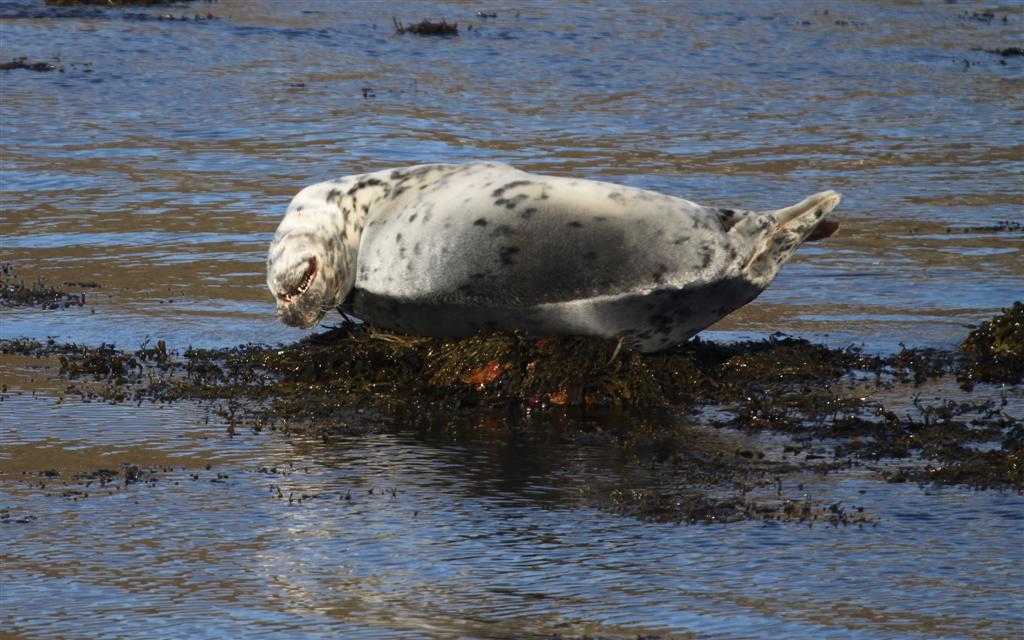
Grey Seals are in good numbers at the moment and can be found huddled on rocks or bobbing around the coastline. They spend on average 80% of their waterborne time underwater and 20% at the surface. Each dive usually lasts between five and eight minutes and they have clever adaptations to help them stay underwater for so long. They take large reserves of oxygen down with them, but not in their lungs as we would. Instead the gas is attached to pigments such as haemoglobin in their blood and myoglobin in their muscles, pigments which have a strong affinity for oxygen. By having a much greater volume of blood than a terrestrial mammal of comparable size, and therefore more haemoglobin, Grey Seals can take a lot of oxygen down without having lungs full of buoyant air which would impair their underwater manoeuvrability. Interestingly, when they do surface for air, their heart rates increase from 40 beats per minute to approximately 120. This allows for rapid gas exchange and allows for more time to be spent in search of food.
Grey Seals come ashore to breed in the autumn, but it is still not fully understood why they haul out at this time of year. The most likely theory is that they come out to dry out their fur and enjoy the heat of the sun, both of which help to conserve energy. That temperature is important is supported by the observation that they always haul out in areas out of the cold wind.
Watching them in their undisturbed environment is fantastic, and with such large mammals perched awkwardly on exposed rocks, comedy moments are plentiful.
Grey Seals enjoying the sun (c) Richard Brown
Grey Seals come ashore to breed in the autumn, but it is still not fully understood why they haul out at this time of year. The most likely theory is that they come out to dry out their fur and enjoy the heat of the sun, both of which help to conserve energy. That temperature is important is supported by the observation that they always haul out in areas out of the cold wind.
Watching them in their undisturbed environment is fantastic, and with such large mammals perched awkwardly on exposed rocks, comedy moments are plentiful.
Yawning Grey Seal (c) Richard Brown
Wheatear numbers are gradually starting to increase and can be seen perched along the walls of the South End and West Coast. The first Chiffchaff of the year was caught and ringed in the Heligoland Trap at the Obs. Small Tortoiseshell butterflies are also on the wing, a good sign that spring is finally here!
Subscribe to:
Posts (Atom)