Friday, June 10, 2011

Wednesday morning seemed incredibly quiet for migrants on the island. I (Giselle) had spent most of the previous day moping about the White-throated Robin in Hartlepool. Not only is it my ringing stomping ground when I'm not on the island, but my ringing trainer Chris Brown was the finder and ringer of this MEGA third for Britain and first for the UK mainland. Even Chris Evans was talking about it on the morning radio show. We finished finding nothing on the South End, and as we approached the narrows we saw that the boat was in, much earlier than usual. Rich then said "do you fancy going to see the White-throated Robin" in a non-serious way. Rich hates leaving the island incase a good bird turns up, so I ignored him with the words "absolutely, lets go now!". We then spent the next 100 metres of walking towards the Obs daydreaming about what it would be like to drive up to Hartlepool and see such a fantastic bird.

At 9:15am I realised that Rich wasn't joking and by 9:30 we were on the boat. The boatman indicated that we were all on the verge of insanity but it was too late, we were crossing the Sound and there was no turning back! We drove through torrential rain, along miles of motorway and as we arrived at Hartlepool at 3:30pm the nerves had set in and a deadly silence took over the car. Despite the reports of crazy wall clambering and ladder loaning on the day of discovery, we joined a mere ten people who were watching it in glorious sunshine, feeding out in the open, tail cocked and looking fantastic. Fish and chips and three bottles of Chris's home-made rhubarb wine later we celebrated our successful mission and Chris's stunning discovery. We still had time for some sneaky views the morning after, before heading back to North Wales for a 3:30pm boat back to Bardsey.

White-throated Robins spend their winters in a relatively small area of Africa extending from the Kenyan plateaus into Tanzania and with some birds in Zimbabwe. They migrate up East Africa to breed in an area extending from Turkey in the West across to Kazakhstan in the East. They are not very sociable birds and are generally solitary on migration. (c) Richard Brown

There have been just two previous British records, a male on the Calf of Man on the 22nd of June 1983 and a female on Skokholm between the 27th and 30th of May 1990. We have therefore probably joined the lucky few individuals who saw these birds in having seen Chough and White-throated Robin the the same day. (c) Richard Brown

The outer unmoulted greater coverts and the knackered tips to the primaries indicate that this is a first year bird. It showed incredibly well for the couple of hours we watched it, hopping across the road to feed under cars on Olive Street before returning to the bowling green poppies. It's a shame that photographers took to standing in Olive Street the following day, the area the bird had fed in for most of the previous day. This no doubt goes some way to explaining the bird's more illusive behaviour since we were there. (c) Richard Brown

So we managed to get back to Bardsey and bird in the evening, just to make sure nothing had slipped in during our brief absence. It hadn't. Dawn broke today and again there were no passage birds. But a stunningly hot and still day made for great invertebrate conditions and we soon found the first Thrift Clearwings of the year. 

This cracking little moth had only previously been recorded in 1980 and 1996 until Rich made a concerted effort to prove the existence of this scarce moth in 2009. He successfully found many individuals in late June and early July near Ogof Ystwffwl Glas on the South End, the same place he found them in 2010 and again this morning. As we went to ring Kittiwakes on the East Side today, he found another adult, a first for this location. Thrift Clearwings are a Notable B, or Nationally Scarce B, that is to say they are only to be found in 31-100 10km squares in the UK. (c) Richard Brown 

Monday, June 6, 2011

June, a time of stunning rares. Last year the first two weeks here saw a White-throated Sparrow and a Greenish Warbler, elsewhere in the country in the last couple of days a Blyth's Reed Warbler and a White-throated Robin have rocked up, today the morning census yielded a new Chiffchaff, yesterday it was three Lesser Whitethroats. But at least we've had a nice pair of hooters to keep our spirits up...

Little Owls were introduced in the late 1800s in Kent and Northampton from where they spread rapidly over most of England, Wales and later into Scotland. They have taken readily to living on the Welsh islands where they seem to do well on the large supply of invertebrates and migrant birds. There are at least three pairs on Bardsey, although they are surprisingly unobtrusive. These two chicks were seen outside of the nest burrow as we approached, the cramped conditions of the burrow meaning that they need to venture outside to stretch their wings and develop their pectoral muscles. (c) Richard Brown

The boys continue to grow at an impressive rate. They are beginning to get their distinctive flat faces and a small bit of pink colouration is now evident. The lower photo shows just how big they have grown in just 21 days (the eggs from which they hatched are on the piece of Rush). (c) Richard Brown

 A couple of impressive behavioural and morphological features are well in evidence at the moment. Rather than just depositing their droppings behind them as they eat, they forcibly shoot them some 20cm or more from their back ends. This is presumably to remove something that may attract predators to them, or perhaps they just don't want to poo on what they eat. The modified hind legs at the back now extend a considerable distance when the boys are disturbed, an amazing anti-predator response. (c) Richard Brown

Saturday, June 4, 2011

We wanted to start this post with a big thank you to all the people who have left such supportive comments about our blog over the last few weeks, they are very much appreciated.

Spotted Flycatchers and Chiffchaffs continue to pass through in small numbers and scarcer late migrants have included another Cuckoo, a couple of Reed Warblers, a Reed Bunting and a few Swifts and Lesser Redpoll. A flock of 15 Collared Doves was notable and bird of the last few days went to a cream-crown Marsh Harrier, the third of the year, which flew north past myself and Giselle as we relaxed with a beer after a hard days seabird ringing. Monitoring the seabirds of Bardsey, and yesterday on the nearby Gwylan Islands, is taking up the majority of our time and our hands and arms are gradually getting more and more battered as successive Shags, Cormorants and Razorbills chew and scratch us as we ring them.

Approximately 1000 pairs of Guillemot breed on Bardsey in many sub-colonies dotted around the coastline. Breeding Guillemots are monitored by counting the number of adult birds occupying suitable breeding habitat. Using a camera makes this process a lot easier as it can be rather tricky from a gently bobbing boat. In this particular photograph there are 57 adults on ledges. (c) Richard Brown

Guillemots nest in tight groups of up to 70 birds per square metre and birds may be in physical contact with several neighbours. They thus defend the smallest known nest-area territory of any bird species, somewhere in the region of 0.05 square metres. This comprises the nest site and an adjacent area on which a off-duty parent may loaf. The territory is used for part of the courtship process, copulation and raising of the single chick. The territory may move slightly if the egg moves. Both adults defend the territory, tolerating adjacent incubators but attacking non-incubators closer than about 15cm. (c) Richard Brown

There are usually around 300 apparently occupied Kittiwake nests each year. Kits differ from most other gulls in that they nest in high densities on small cliff ledges and build more elaborate nests which are not camouflaged. Older birds generally nest closer to the centre of the colony and lay their eggs earlier than the younger, less experienced birds which frequent the edges. 

We visit the nearby Gwylan Islands each year as part of our seabird monitoring programme. Here there are up to 130 pairs of shag, 80 pairs of Cormorant, 60 pairs of Great Black-backed Gull and 1000 pairs of Puffin along with smaller numbers of other auks and, for the first time this year, a pair of Canada Goose. This is the view from Ynys Gwylan Fawr to Ynys Gwylan Bach with Ynys Enlli (Bardsey) in the distance. (c) Giselle Eagle

Giselle having ringed her first Cormorant chick. This year is looking really good for Cormorant with many large young throughout the colony. (c) Richard Brown

Young Cormorant are usually fed twice a day, once by each adult, on regurgitated fish. If the chicks are thirsty they beg with an upwards wave of a wide open mouth. This encourages the off-duty parent to go and fetch water in their throat for the chicks to then drink. (c) Richard Brown

This adult male Shag was one of over 80 Shags ringed on the Gwylans yesterday. It was sexed by the way it was calling. Males grunt loudly, a noise which can be heard for up to 300 metres. Females make throat clicking noises, as can males, but they are otherwise voiseless. The lower photo shows Rich ringing the bird in the best way so as to avoid being lacerated. (c) Giselle Eagle

Great Black-backed Gull chicks may leave the nest as soon as they are dry after hatching or may remain in the nest for a couple of days before hiding, incredibly well, nearby. The adult birds make mewing calls to stimulate the chicks to beg for food. The young chicks will then feed from the adult's bill, but as they get older the adults will regurgitate their food onto the ground. (c) Richard Brown

Puffins are monogamous and show very high nest burrow fidelity. They first breed when they are five or six years old. Immature birds younger than this will start to visit colonies at this time of year when the breeding birds are busy bringing in Sand Eels to their young. The immature birds visit the colony progressively earlier as they age each year until they breed for the first time. (c) Giselle Eagle

The view home after a fantastic sunny day spent seabird monitoring. A beer on the boat, as Manx Shearwaters glided alongside, finished it off nicely. (c) Giselle Eagle

Wednesday, June 1, 2011

The only migrants of note have been a lingering Cuckoo, a smattering of Spotted Flycatchers, Chiffchaffs and Sedge Warblers, and a few House Martins and Swallows overhead. But we have been flat out monitoring Bardsey's breeding birds. We have been continuing to colour ring the Chough nestlings and yesterday we made our first visit to the Seal Cave Razorbill colony.

The vast majority of Razorbills are still incubating eggs, but a few adults were seen delivering Sand Eels to tiny, but very hungry chicks. Both adults go out to fish but they usually take turns when the chicks are small. The fish are offered to the single chick one at a time, either by the arriving fisher or the remaining adult. (c) Richard Brown

The adult birds have stunning lemon yellow insides to their bills. The chick, almost from the moment of hatching, pecks at the white stripe on the adult's bill to encourage them to provide food. (c) Richard Brown

Razorbills have almost triangular legs. The rings we fit are designed to match this shape, with a flat bottom below the leg and angled sides. This makes the ring numbers relatively easy to read and a visit to the colonies can produce a good number of field sightings. This adult, M75549, was ringed as a chick, in the same colony, in June 1991. As of 2009, the oldest ringed Razorbill in the world was to be found on Bardsey, still nesting at the grand old age of 41years 11months and 23days old. (c) Richard Brown

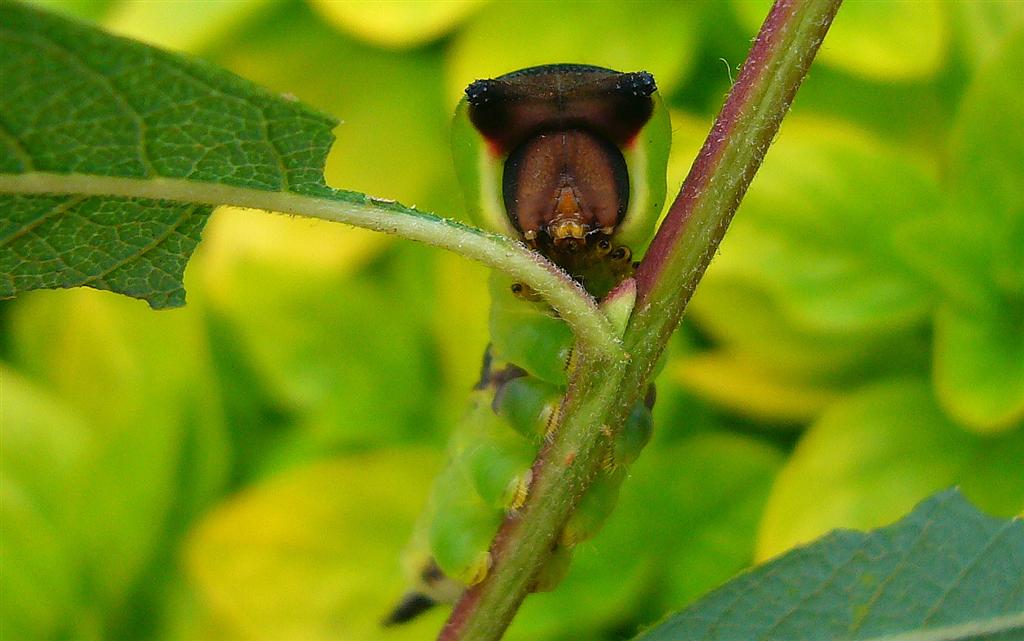
Another Puss Moth update! All 13 caterpillars are in a feeding frenzy and growing greener and fatter very rapidly. After checking the original egg laying site, we noticed the eggs that remained had started to hatch but appeared to have perished. We took them in, just in case, and two of them hatched! The size difference is remarkable between the two considering there is only a two week age gap. (c) Richard Brown

Saturday, May 28, 2011

I can't remember the last calm day. But a few birds are still passing through the island, most notably a rather late Short-eared Owl which we found on the South End yesterday morning. A trickle of Sedge Warblers, Chiffchaffs and Spotted Flycatchers, along with a few flyover Redpolls and Swallows, are the only obvious migrants. So attention has turned to our breeding birds and we have been busy locating nests and ringing young. Yesterday we ringed a fantastic brood of three Peregrine chicks which were all a very good size. The masses of Manx Shearwater wings around the nest suggest that the adult birds are doing well at making the most of this abundant source of food.

 The breeding Oystercatcher and Chough were not impressed with the Short-eared Owl. (c) Richard Brown

One of several broods of Pied Wagtails which seem to be doing well in the outbuildings. (c) Richard Brown

Destined to become one of Britain's most hated birds, a robber of nests, a terroriser of bird tables, the subject of daft superstition and the nickname of the greatest Premier League football team. This magpie chick was one of three ringed from a gorse-top nest on the South End and the 59th species to be ringed this year. (c) Richard Brown

Another day, another Puss Moth update. The lads have started their second moult and are emerging with big faces and spotty flanks. (c) Richard Brown


Wednesday, May 25, 2011

We've been busy over the past couple of days doing a whole island Oystercatcher census. While walking the entire coastline to map territories and record clutch size, I (Giselle) took the opportunity to photograph a few nests. The amount of scrape lining varies markedly from nest to nest, but what's even more fascinating is the material used to line.


Short pieces of dead gorse twig were used in nests on the South End, where gorse is the predominant vegetation (top middle, bottom right). On the more rocky outcrops, nests were lined with small fragments of rock and shale (top right) and in areas where the sheep have been, a couple of pairs decided to waste not want not and lined their nests with sheep dottle (bottom middle). (c) Giselle Eagle

Some nests have very little lining at all, such as the four-clutcher (top left). A lot of pairs seem to locate their nest scrapes next to a prominent feature such as large boulders, but on a shingle beach, nest location may prove difficult, so one pair has cleverly built their scrape next to a large thrift plant (top middle). And finally, a conservation-irony in the bottom left - one pair that nests on the South of the island always chooses to line their scrape with snapped off pieces of Sharp Rush, a nationally scarce plant species and one of the features of the National Nature Reserve. (c) Giselle Eagle

The strong winds are still with us and landbirds are a little thin on the ground. Spotted Flycatchers remain the most abundant passerine migrant. (c) Richard Brown

Tuesday, May 24, 2011

The Woodchat Shrike seems to have taken up residence above Nant valley and we have been lucky enough to spend quite a lot of time watching it. It appears to be feeding in quite wide circuits, which has kept Rich on his toes trying to photograph it. Or rather off his toes and in a stealthy stomach-crawl through the gorse.

Woodchat Shrike amongst the gorse above Nant (c) Richard Brown

The bird is clearly feeding well and we've been trying to figure out what its been eating. It has taken a few bees and we've also watched it eat a Click Beetle. While Rich was crawling through the gorse, I (Giselle) spotted it coughing up a few pellets. We waited for it to leave its perch then crept in and collected a rather soggy, malformed pellet.

The remains of a Green Tiger Beetle and three grubs are obvious. The rest of the pellet seemed to consist of unidentified beetle remains, mostly legs and wing casings. (c) Richard Brown

Further evidence that the Shrike is feeding well. We wont be rushing to collect this sample. (c) Richard Brown

A quick update on the Puss Moth caterpillars. They're munching through a lot of willow leaves at the moment, and therefore getting much bigger. Since their first instar moult, they've started to turn greener on their flanks. And we still have all 13 of them!

 The rear legs of the Puss Moth Caterpillars have evolved into long whip-like appendages. When the caterpillars sense danger they flail their whips around to deter the predator. They also have the ability to spray formic acid from their heads if the threat remains. (c) Richard Brown