Sunday, September 30, 2012

We've been away from Bardsey for the past week. It was inevitable that we were going to miss a bird or two; it was the last week of September after all. At the start of the week it seemed as though we might get lucky; howling winds and persistent rain kept attention focused on a rather quiet sea. But with so much having arrived on the East Coast, and with the winds dropping, it was only a matter of time before Bardsey would collect another Welsh Rare. It came in the form of a rather brief but obliging Little Bunting, the first since 2005 and only the 13th for Bardsey. The following day saw a skulking Locustella which was probably smaller than a Grasshopper Warbler. We had only been back on the Island for an hour when a Barred Warbler was located near the Chapel. It was clearly on a mission and soon flew over the assembled crowd and off up the mountain.

So why leave such a fantastic place in the last week of September? Well there would have to be a pretty good reason. And there was. The Wildlife Trust of South and West Wales were looking to appoint a new Warden for Skokholm. We are very pleased to announce that they have appointed two. From the start of January we will be the Skokholm Island Wardens! Skokholm is home to approximately 20% of Europe’s breeding Storm Petrels and 15% of the world population of Manx Shearwaters. The seabird assemblage is of international importance. Throw in a few Nationally Scarce species of Lepidoptera and plants, a spectacular landscape of old red sandstone, Skokholm’s reputation as a migration hotspot and it is no surprise how excited we are. It hasn’t really sunk in yet. Skokholm was also Britain’s first Bird Observatory, started by Ronald Lockley in 1933. It is a real honour to be able to follow in the footsteps of such a pioneering naturalist. We would like to extend a massive thank you to everyone who has helped and supported us on Bardsey, and to all the guests who have become good friends over the years. We will of course be hoping to see you all on Skokholm in the future.

We are very excited about having a final autumn on Bardsey and hope to go out with a bang (well a nice selection of rares anyway).  

The Barred Warbler which greeted us back on Bardsey. There seems to be a moult contrast in the greater coverts of both wings. This, coupled with the limited barring to the underparts and the broad pale edges to the tertials and secondaries, suggest a bird of the year. (c) Richard Brown

Although our trip to Pembrokeshire this week was on business, there was a bit of time to go birding. The Wryneck on Skomer is a long-stayer and is frequenting the same bushes where I saw many a Wryneck during my time as Assistant there. The Glossy Ibis is right outside the Marloes Mere YHA where we were staying. This bird has been back and forth to Ireland a couple of times during its stay. It has also visited Skokholm (we can only hope that it continues to do so next year)! But these movements are tiny compared to what it's capable of - recently observations of a ringed bird revealed a movement of 600km in a single day. (c) Richard Brown

Sunday, September 23, 2012

It's been a week of seawatching with little in the way of island-based excitement. Nine Red-throated Divers, three Black-throated Divers, two Great Northern Divers, 17 Sooty Shearwaters, seven Balearic Shearwaters, 29 Leach's Petrel, ten Pomarine Skuas, 68 Arctic Skuas, three Long-tailed Skuas, 56 Great Skuas, two Mediterranean Gulls, a Little Gull, a Sabine's Gull, a smattering of commoner terns and a Black Guillemot have all joined the commoner birds passing by. A big shearwater and a small shearwater both got the pulses racing for two lucky (or unlucky) observers, but we sadly didn't connect. Giselle's Melodious Warbler showed amazingly well and when re-trapped was found to have put on 20% of its body weight. It stayed a couple more days before departing on the clear night of the 18th. A brief flyover Hobby brightened our day on the 20th and yesterday morning a large pipit became yet another bird that got away. Silent as it flew over Rich and the South Tip, it was in the company of Goldfinch. The Goldfinches returned from the sea, but no sign of the pipit. The most intergalactic event of the period is documented here: http://www.universetoday.com/97507/fireball-meteor-or-re-entering-satellite-something-broke-up-over-the-uk-on-friday/ but the chances of anything coming from Mars are a million-to-one. About the same chances of finding a BB rare on the South End.

With nearly 30 Leach's Petrels recorded at sea, it was no surprise when Rich found this little fella at the bottom of the Lighthouse during a passing squall. William Elford Leach was an expert in crustaceans and molluscs but also spiders, mammals and birds. He purchased a petrel such as the one above for the British Museum for the princely sum of £5 15s in 1819, and a year later Coenraad Temminck, of Stint and Lark fame, named it after Leach. Leach also purchased a Great Auk and its egg at the same time. This is the third Leach's Petrel we've caught at the Lighthouse in three years. (c) Richard Brown

Wednesday, September 12, 2012

Northwesterly winds promised a bit of action at sea, but they never really delivered. One lucky observer had a distant Sabine's Gull and a couple of Black Guillemots whilst the rest of us only managed a couple of Black Terns and a few of the commoner skuas. The highlight has been Giselle's Melodious Warbler which continues to delight all comers in the Observatory garden. When she first trapped it the fat and muscle scores for the bird were a lightweight 0/0. The fat is the bird's primary energy reserve and is quickly gained and lost by migrating passerines. The muscle score is a measure of the size of the pectoral muscles whose proteins are used as fuel by migrants. So the Melodious had basically used up all of its fat reserves and wasted its pectoral muscles to get here. But since it has been gorging itself on flies in the back garden and will soon be ready for the off - hopefully in the right direction this time.

Of the ten Melodious Warblers reported in the UK since the 1st of August, we have recorded two of them. Only St. Mary's has managed the same. (c) Richard Brown

The bird is very active, constantly on the look out for insects. Its head is always darting around to spot the next victim. It then either flies at the insect and grabs it or, as in the bottom photo, slowly sticks its neck out before striking out gecko-fashion with a quick lunge. The quickest way to find the bird in the Obs garden is to listen out for the snap of its bill, a sound much louder than that made by the Phylloscs. (c) Richard Brown

An Icterine Warbler (on the 26th August last year) and Chiffchaff also making the most of large flies. (c) Richard Brown

Most of the Manx Shearwaters are now fledging. Youngsters that haven't made it out to sea or back down a burrow are easy pickings for the Great Black-backed Gulls and Crows. (c) Richard Brown

Friday, September 7, 2012

It has been very quiet bird-wise since our last post. So quiet in fact that we've spent a fair bit of time bothering undergrowth in an attempt to improve our chances of catching birds when they do arrive. The new plantation at Nant has held some pretty decent birds in the last year or so, ranging from a Corncrake to a Western Bonelli's Warbler. But the vegetation had grown taller than the nets and there was a big section of impenetrable woodland which has no doubt held several BB Rarities during the course of the year so far. So we pollarded the trees and stuck in a new 50 foot net ride through the middle. Subsequently there has still been virtually nothing in the way of grounded migrants, although one day saw over 5000 Swallows pass North and many Grey Wagtails have gone over (using an old water bottle off a bike we also created a constant drip of water next to one of the nets to try and lure a Grey Wagtail or two down - but it's yet to work). Anyway, the first reward for all our efforts came today. We had only caught about five birds when Giselle extracted the third Melodious Warbler of the year from our new net ride. Despite the area having been well birded, the first we knew about it was when Giselle found it hanging there - what else must have skulked through this dense patch of scrub?

This neat first year arrived on a good day for Hippos. On Bardsey since 1958, the seventh of September has seen seven previous Melodious Warblers and three Icterine Warblers recorded. So eight of 113 Melodious Warblers have occurred on this date. (c) Richard Brown

Several Hummingbird Hawkmoths have been in the gardens along with numerous Silver Ys. Three Migrant Hawkers have also passed through. (c) Richard Brown

Sunday, August 26, 2012

Well it wasn't all bad getting stuck off the Island for an extra couple of nights. When news broke on the evening of the 21st that there was a Broad-billed Sandpiper at Seaton Snook, we were already well into our third pints down the local. It was perhaps a bit hopeful to expect the bird to return to the same high tide roost the following evening, but it did. The crappy digiscoped images don't really do justice to the views we had, but it was cracking. The bird usually kept a lower profile than the Dunlin, crouching down in dips and troughs. As the flock worked up towards the gathered crowd of 20 or so birders, we were all hoping for some great views. But the flock was quite active and various dog walkers were not helping them to settle. But the birds kept getting closer. However, for no apparent reason, the star bird suddenly departed with a small group of Dunlin and was last seen flying high over the South side of Teesmouth, perhaps on its way to Nosterfield. But even without the sandpiper, it was an excellent roost. The tern flock, primarily made up of a three figure count of Common Terns, also held a few Arctic Terns, a couple of Sandwich Terns, two Black Terns and an adult Roseate Tern joined the group late on. Two Curlew Sandpipers were with the Dunlin flock.

Rather poor photos of the juvenile Broad-billed Sandpiper and a Black Tern. This is a truly fantastic site, but it is sadly disturbed by dog walkers on a far too regular basis. Surely there must be a way of dissuading people from the Seaton Snook area at high tide? The vast majority of dog walkers are totally oblivious to the disturbance they are causing, indeed most were oblivious to the big group of people watching them walk through the birds. Perhaps some big dog shaped signs could kindly ask them to walk their dogs on the couple of miles of beach in the other direction? This was only the second Broad-billed Sandpiper of 2012 following on from one in the Outer Hebrides back in May. (c) Richard Brown

A little way to the South, at Lockwood Beck, the Osprey was again showing very well, occasionally fishing below where we were sat. Our yearlist, severely hampered by nine weeks in the Caribbean, scraped over the 200 mark with this bird (watch out Tonks and Aimes, we're coming). (c) Richard Brown

Back on Bardsey and a trickle of migrants are continuing to pass through. It's been a great autumn for Pied Flycatchers with numbers considerably up on recent years. The broad white outer edges to the tertials which step in at the feather shaft show this to be a bird hatched this year. Hopefully many people recognise this particular plumage from our little competition at the BOC stand at the Birfair. (c) Richard Brown

Wednesday, August 22, 2012

It has been ages since we've blogged. Our only excuse is that we've been quite busy. Back on Bardsey we have managed to build a second Heligoland Trap in the Obs garden. We were inspired by the fact that the original trap has provided us with an average of exactly 450 new birds a year between 2000 and 2011. Also by the decent birds which have recently been taken in the original, including Woodchat Shrike, Melodious Warbler and Greenish Warbler. It hasn't been easy, but we have now managed to build a second trap which uses the east wing of the original to form the new trap's west wing. The new trap thus catches birds approaching from the South whereas the old trap takes birds coming from the North. But we'd only just finished the trap (and caught the first few Willow Warblers in it), when it was time to leave Bardsey to represent the Bird Observatories Council at the Birdfair. We've missed a few birds whilst we've been away, most notably record numbers of Pied Flycatchers along with a Hobby, a Wood Warbler, a Wryneck, a couple of trips of Dotterel and a few more 100+ Willow Warbler days. However we can't really grumble as we had a cracking time at the Birdfair. We're now waiting for the weather to allow us to return to Bardsey, with Thursday looking like it will be good for a crossing. Whilst we wait we've picked up a few more birds for the yearlist, most notably the Black Tern and Black-necked Grebe just down the road at Nosterfield and the very showy Osprey at Lockwood Beck Reservoir.

Our new Heligoland Trap in the Obs garden. Many a Subalpine Warbler has vanished into the Gorse in this part of the garden; hopefully a few will now find the back of the trap. With the exception of the chicken wire, the whole trap has been made out of offcuts and unwanted materials lying around the island. (c) Giselle Eagle

Monday, August 6, 2012

A few Willow Warblers in the South End Gorse early on suggested that migrants were on the move. But it was only when we crossed the Narrows that we realised that it was going to be a pretty decent day. The first withy we came to held nine more Willow Warblers and Rich located a Melodious Warbler. It showed well and eventually found a mist net. Often the best way to pick it up as it moved through the vegetation was by the sound of its bill snapping shut on insects. It was clearly feeding well so it was no surprise that its body was surrounded by a layer of fat. Willow Warblers continued to move through during the day; tonight's adding up will no doubt give a figure of well over 150. Add to this a Whinchat, two Spotted Flycatchers and a Tree Pipit and autumn is well and truly under way. 

The first Melodious Warbler to be reported in the UK this autumn. The fresh plumage shows this to be a bird of the year. Adults do not moult until they reach their wintering grounds so their plumage shows the wear picked up during the breeding season. This is the 112th Melodious Warbler recorded by BBFO since 1953! Why Bardsey is so attractive to these short winged Hippos is not clear. (c) Richard Brown

This is the ninth year that Redpolls have nested on Bardsey, but the first time with more than one pair. The three pairs have fledged a minimum of seven between them, a new island record. This smart male is currently feeding three streaky brownpolls. (c) Richard Brown

Although this lingering Cuckoo spent a lot of time begging at the Meadow Pipits, it probably came from the mainland. It spent most of its stay gorging on Six-spot Burnets. (c) Richard Brown

Sunday, July 29, 2012

We don't get to see too much in the way of dragonfly action in a normal year on Bardsey. The fresh water areas on the island are eutrophic in nature, and whilst this favours the abundant Palmate Newt, it means that only Blue-Tailed Damselfly breed here with any regularity. So while we were traversing the north-west coast of Scotland, we went on a Dragonfly hunt!

This impressive male Golden-ringed Dragonfly was hanging out in a bog near Loch Morar (which incidentally is the deepest freshwater body in the British Isles with a maximum depth of over 1,000ft). Females have a distinctive 'spiked' vulvar scale, diagnostic of the genus, which aids in the oviposition of eggs in streams and ditches. The larvae of this species live for 3-7 years before emerging as adult dragonflies. (c) Richard Brown

Keeled Skimmers were abundant in the same bog, with multiple females egg-laying in the shallow ditches. The smart males, such as this one, were duelling it out over the prime stretches. Keeled Skimmers are common in Southern Europe, but only locally common in Western Britain and Ireland. (c) Richard Brown.

Perhaps the most confiding of all the Dragonflies on the bog was this female Northern Emerald (thanks Andrew!). Although not very visible in this photograph, the two large yellow spots on the third abdominal segment and a broader waist readily separate it from the male of this species. In the UK it is confined to north-west Scotland. (C) Giselle Eagle

Keeping the emerald theme going, this time with a smart male Common Emerald Damselfly that we encountered in another bog on Muck. Males are separated from females by a number of features. Eye colour is blue in males but dark in females. Males show a blue pruinosity (a waxy colouring which develops as the damselfly matures and covers the underlying colouration) which covers all of Segment 2 (which also helps to separate it from the the more southerly Scare Emerald Damselfly), and blue S9/S10 with a distinctively shaped abdomen tip. All Emerald Damselfies share the characteristic 'spread' wings at rest, with all others holding their wings closed. (c) Richard Brown

This probable Highland Darter Sympetrum (striolatum) nigrescens was basking on stones near the bog. Some publications question its validity as a separate species suggesting that it is just a melanistic form of Common Darter S.striolatum. Either way, the lack of yellowish streaks on the femora and the dark sides to the thorax, coupled with large amounts of black around the edges of the eyes and the blackish underside to the abdomen, suggest that this is of the highland form. Interestingly, early odonatologists suggested that Highland Darters were the product of hybridisation of Common Darter and Black Darter and this continues to be a long-standing debate. Recent genetic studies have shown some evidence of isolation from Common Darter, especially on Scottish Islands, resulting in restricted gene flow. It is still suggested, however, that Highland Darter is merely a northern morph of Common Darter. (c) Richard Brown.

And finally a straight-forward, no-nonsense, Large Red Damselfly. Exactly what it says on the tin. (c) Richard Brown.

Friday, July 27, 2012

I thought Rich needed a rest from his Greenish Warbler research, so I booked a holiday in a yurt on the Isle of Muck for the last week of our holiday. It was phenomenal! Corncrakes crexing from the meadows were the avian highlight, although we did see Twite, which was new for the yearlist. The mega highlights of the holiday, however, all came from the depths of the sea...

On our first day trekking around an island only slightly bigger than Bardsey, we got some distant views of two Basking Sharks feeding in the waters in front of the Isle of Eigg. We watched them for half an hour or so before heading on - there was still a lot of coastline to explore! We hoped we'd get closer views. A couple of days later, we spotted another Basking Shark, very close in to shore. The only problem was we were viewing it from Beinn Airein - the highest point on the island. We made a hurried descent to the bay and watched the shark feeding close in for a couple of hours! Brilliant! Then, on our last night as we enjoyed a few ciders, a Basking Shark appeared in the bay opposite the yurt.

Adult Gannet, Great Black-backed Gull and Shag to give this enormous sea-beast some scale. This particular shark seemed to be around 12ft long, which is big enough, but massively shorter than the largest specimen ever reported, which was trapped in a herring net in the Bay of Fundy, Canada in 1851 and measured in at a whopping 40ft and tipped the scales at an impressive 19 tonnes! Sadly, the commercial value of Basking Sharks as food, animal feed and sharks liver oil (not to mention the appalling trade in sharks fin) has resulted in over-exploitation of this species and so long-lived individuals like the 1851 specimen are rarely recorded now. Basking sharks filter-feed on blooms of plankton, small fish and invertebrates in the water column and can get through as much as 1800 tonnes of water an hour. (c) Richard Brown

Sea-beast the Second! After the excitement of the Basking Shark, came the excitement of the elusive Otter. Yet again the yurt was the place to be and we watched this large individual catching fish just offshore. It's no surprise that he was busy eating, British Otters need to consume somewhere in the region of 15% of their body weight per day to enable them to survive in our chilly waters. (c) Richard Brown

A somewhat distant Minke Whale which didn't quite make it onto the yurt list. The Minke Whale is apparently named after Miencke, a Norwegian Whaler who became the butt of his crewmates' jokes when he repeatedly harpooned this species thinking that it was the much larger Blue Whale. They crew dubbed this smallest rorqual whale 'Miencke's Whale' and the name eventually stuck. (c) Richard Brown

The yurt overlooking the much larger Isle of Rùm where several tens of thousands of pairs of Manx Shearwater breed high up in the Cuillin Hills. Which goes some way to explaining their constant presence in the waters around Muck. It seems a few pairs have started to breed on Muck but, as on Rùm, the presence of non-native rats will not be helping their productivity. (c) Richard Brown

So we're now back on Bardsey, and just in time. It might only be the last week in July but autumn is well and truly under way. Over 100 Willow Warblers have been logged for the last two days, predominantly birds of the year, along with the first few Sedge Warblers and Grasshopper Warblers heading South. Up to 13 species of wader have been around the coast and Swifts are screaming their way South. 

The first Grasshopper Warbler of the autumn was predictably a nice fresh bird of the year. Little is known about Grasshopper Warbler migration but it is likely that this smart Locustella will visit important refuelling sites in Portugal before reaching its wintering grounds in North Africa. (c) Richard Brown

Tuesday, July 10, 2012

We've been given a few more pointers on the separation of Greenish Warbler and (Bright) Green Warbler. It's not going to help to secure the identification of our bird, but it does provide a few more talking points. The reason that Green Warbler has been suggested is due to the extent of yellow in the supercilium and ear coverts, which seems to be on the extreme side for Greenish Warbler, however see: http://birdsofkazakhstan.com/greenish-warbler-phylloscopus-trochiloides/ for photographs of Greenish Warbler in South Kazakhstan (but different light conditions). The chin, throat and upper breast have a pale yellow wash in our bird, but this seems to be within the realms of Greenish Warbler.

A new feature to us (and apparently said by some to be diagnostic) is the possibility that the feathering along the lower edge of the eye is white (thus contrasting with the ear coverts) in Greenish Warbler and matches the colour of the ear coverts in Green Warbler. It is important that this is assessed in good light conditions so perhaps we can't look at it with any certainty using these photos. However it seems fair to say that our recent bird has feathering more concolourous with the ear coverts than the other two birds, but perhaps not to the extent expected in Green Warbler? The three photos below are full size so anyone out there who's interested can blow them up a bit bigger for a closer look. The lack of yellow in the wing bar seems to have no relevance as fresh Green Warblers on the Turkish Black Sea Coast can show white wingbars when fresh. Ultimately it seems that some extralimital, worn birds cannot be identified without DNA analysis or a sonogram.

We would be very interested if anyone out there knows about leg colour (which was surprisingly pale in this bird), or the patterning of white on the inner web of the outer tail feather which in this bird was as would be expected in Greenish Warbler.

The Bardsey Green(ish) Warbler (upper photo) clearly differs from our two other recent Greenish Warblers (middle photo 11 June 2010, lower photo 8 June 2012). (c) Richard Brown

Saturday, July 7, 2012

Our busman's holiday has continued with a few days of birding, ringing and a quick twitch. The smart male Red-backed Shrike at East Chevington was too close to ignore, so we went to pick it up for the year list and complete the three commoner shrikes hat-trick (watch out Tonk and Aimes, we're getting closer). We had a fantastic day's ringing around Teesmouth with a few wader pulli, including Rich's first Avocet, and fifty plus passerines including lots of Reed Warblers and dispersing juvenile warblers.

The East Chevington Red-backed Shrike was somewhat distant and seemed pretty happy to stay in the large patch of sheltered scrub down to the south of the hides. Considering that it is smaller than a Starling, this voracious carnivore is something of a monster, capable of taking small mammals, reptiles and birds along with its more usual prey of insects. The Germans call them Neuntöter, referring to the superstition that they only feed after they have killed nine creatures. (c) Richard Brown and Giselle Eagle

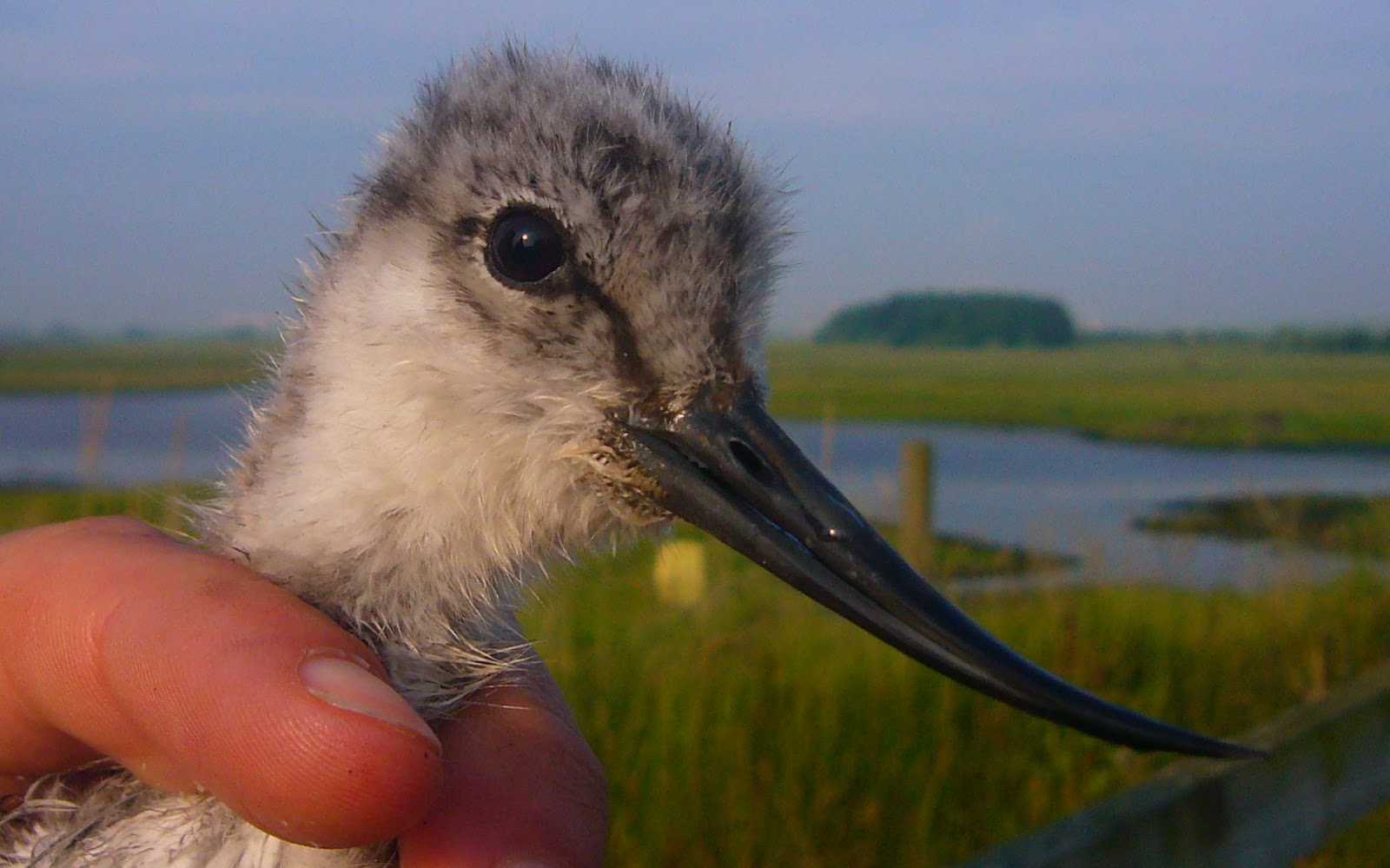
Avocet and Ringed Plover pulli. Productivity isn't looking too good this year, perhaps due to the attentions of local foxes. (c) Richard Brown

Monday, July 2, 2012

A brief weather window meant that we could get off Bardsey for a 'summer' holiday. The interesting Green(ish) Warbler continues to cause debate, so we intend to continue our research whilst we're off. But today we were constantly distracted by news of the Alpine Swift which was continuing to show well at Buckton Cliffs to the North of Bempton. The forecast was bad, it was already two in the afternoon, but we fancied a drive so headed out for the two hour trip. The forecast was right. We made the mile plus walk to the trig point in something between drizzle and rain. But the bird was still there, feeding low along the cliff edge. It frequently passed just a few feet over head, but it wasn't the best conditions for photography. However it was well worth the drive to spend an hour in the company of this monster Swift which has a wing span of over half a meter.

This cracker has lingered since the 29th of June, the most predictable of the 21 birds to have been reported in the UK so far this year. Alpine Swifts pair for life and return to the same nest site each year, so perhaps this bird isn't an established breeder. But they can also range long distances when looking for food. Whilst the adults are away hunting, the chicks can lower their body temperature to reach a torpid state, thus surviving unattended for long periods. (c) Richard Brown